
Skip to content

SHIPPING ADVICE · EQUIPMENT CARE

How to Pack a Reel-to-Reel Tape Recorder for Shipping

A practical guide for sending your recorder for repair or servicing.

Reel-to-reel recorders combine considerable weight with delicate mechanical parts. Bent spindles, broken switches, cracked cabinets and damaged tension arms can turn a routine service into an expensive restoration.

Good packaging must support the weight, cushion impacts and keep pressure away from vulnerable parts.

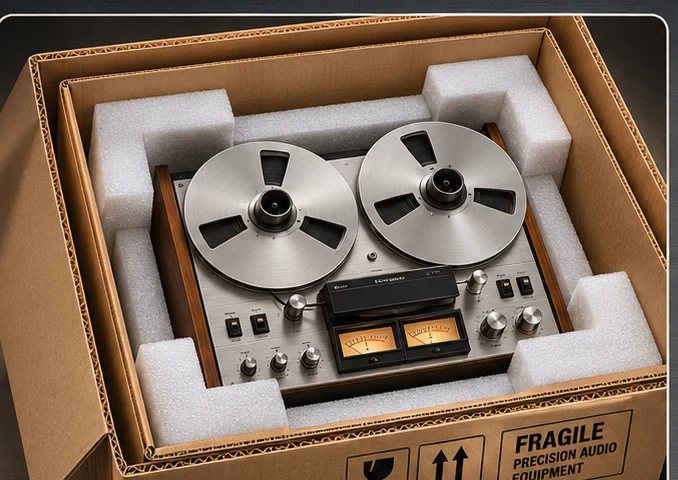
Illustration of a reel-to-reel recorder supported with foam inside a shipping carton
Illustration only: protect projecting components and remove reels before actual shipping.

TEN STEPS · FROM WORKSHOP BOOKING TO COURIER COLLECTION

Prepare your machine for a safe journey

01

Speak to your repair specialist

Before booking a courier, confirm that the workshop accepts shipped equipment and has agreed to receive your recorder. Ask for model-specific packing instructions, a reusable shipping kit if available, which accessories are required and how the machine will be packed for return.

Workshop tip — expand for advice

A workshop-approved packing kit is often the most straightforward option. Model-specific instructions take priority.

02

Photograph and identify the deck

Photograph every side of the recorder, its serial number, existing marks, reel spindles, controls, meters and tape path. If safe, record a short video showing the fault. Include a written service note with your name, phone, email, return address, make, model, serial number, booking reference, fault description and any accessories enclosed.

Workshop tip — expand for advice

Photograph the packing process and finished parcel; retain the images until the recorder returns.

03

Remove reels and loose accessories

Turn off and unplug the machine. Remove all tape, both reels and—unless the workshop advises otherwise—detachable NAB adapters. Keep unnecessary covers, cables and accessories at home. Wrap required accessories individually and secure them in a separate protected space. Never ship the deck with reels mounted on its spindles.

Workshop tip — expand for advice

Ask before removing a wooden cabinet, rack ears, feet, handles or other fitted components.

04

Follow the correct transport procedure

Some recorders need transit screws, transport locks or manufacturer-specified restraints; others do not. Follow the manual or workshop instructions precisely, especially when protecting moving tension arms. Do not force mechanisms, tighten unknown screws or tape moving controls into place.

Workshop tip — expand for advice

Do not put adhesive directly on lettering, veneers, painted surfaces or aged plastic.

05

Protect spindles, controls and tape path

Provide clearance around reel spindles and retainers, tension arms, tape guides, capstan, head assembly, knobs, switches, meters and rear sockets. Use purpose-made spindle protectors or approved inserts. Foam must support sturdy cabinet or chassis areas, not press onto protruding components. Never force spindle ends into solid foam.

Workshop tip — expand for advice

Imagine the parcel face-down: the full weight must remain off its controls, spindles and tape path.

06

Use materials that support the weight

Choose new, strong double- or triple-wall cartons rated for the machine’s weight, fitted cushioning foam, corner supports, a clean non-abrasive protective layer, supplementary large-bubble wrap and strong sealing tape. Loose packing peanuts, newspaper, towels and thin bubble wrap should not be the primary support.

Workshop tip — expand for advice

More padding does not necessarily mean better protection: it must bear the load without collapsing.

07

Pack the inner carton

Place substantial cushioning under the machine, then fit stable side and corner supports. Leave protected clearance around front and rear projections. Add top cushioning that locates the deck without pressing on controls. Gently check that it cannot shift, and close the carton without forcing the flaps.

Workshop tip — expand for advice

Never lift a machine by its spindle, tension arms or controls; seek help for heavy decks.

08

Double-box for additional protection

Unless the workshop provides an approved alternative, double-box valuable machines, especially large 10½-inch-reel decks. Place a closed inner carton inside a stronger outer carton with cushioning underneath, above and on every side. Prevent any contact or movement between cartons. General fragile-item guidance often suggests about 8 cm (3 inches) of clearance, provided the packing is suitable for the weight.

Workshop tip — expand for advice

Measure the fully protected deck before selecting carton dimensions.

09

Seal and label properly

Use H-taping on both the top and bottom of each carton, sealing centre and edge seams. Place a duplicate address and contact sheet inside. Attach the shipping label to a flat surface away from seams, and remove old labels. FRAGILE and THIS WAY UP are helpful handling requests, not a substitute for protective packing.

Workshop tip — expand for advice

Prepare the parcel to survive being placed on its side, regardless of orientation labels.

10

Choose suitable transport

Measure and weigh the finished parcel; confirm the carrier accepts its size and weight. Check damage-cover conditions, used vintage audio exclusions, packaging rules and proof-of-value requirements. For unusually valuable or large studio machines, consider hand delivery, specialist equipment couriers or professionally packed pallet freight. Agree return shipping in advance.

Workshop tip — expand for advice

The journey home deserves the same standard of packing and cover.

PRE-COLLECTION · 15-POINT VERIFICATION

Final checklist — before collection

Tick each point as you prepare the shipment. Selections remain only in this browser view and are not sent or saved to a server.

0 of 15 checks completed
01 · Before you pack0 / 5 complete
02 · Protect and immobilise0 / 6 complete
03 · Seal and hand over0 / 4 complete

On arrival

Photograph any visible packaging damage before unpacking. If damage is discovered, retain all cartons and cushioning and follow the carrier’s reporting process promptly.

If the recorder arrives cold, let it reach room temperature and allow any condensation to disappear before reconnecting power.

A well-packed recorder is supported, cushioned and immobilised—with every delicate projection protected from pressure.

fWAinXTG@